In a previous post, I talked about my French press coffee maker which has no fill level marks to help me add water to the same place every time. This short video introduces that post, and shows you my current French press. It is for people who own French press coffee makers AS WELL AS designers and anyone interested in innovation and creativity. It also shows the mind map you can explore while learning some proximity thinking at the same time!
Category Archives: ProxThink Basics
My Bodum French Press Could Use Some Proximity Thinking
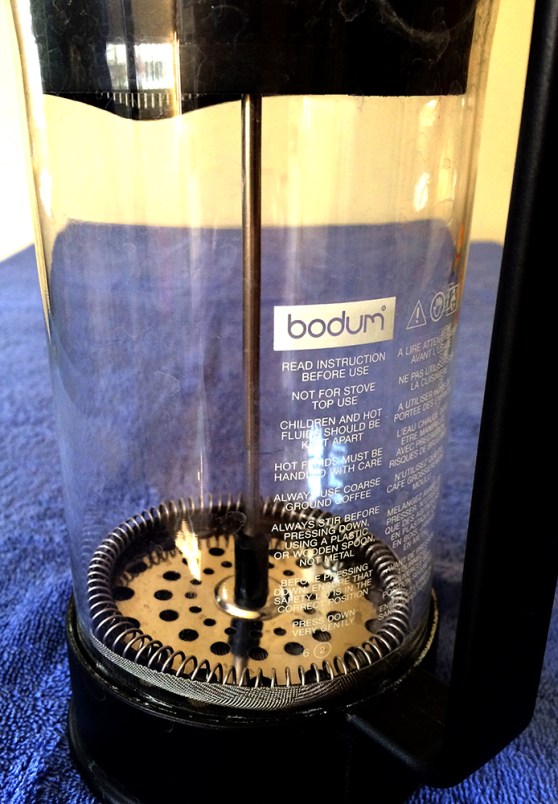
My French press coffee maker, by Bodum, could use some proximity thinking. More specifically, it has no fill level marks to help me add water to the same place every time, as you can see from the picture.
UPDATE: I made a short video intro to this post! You can watch it here.
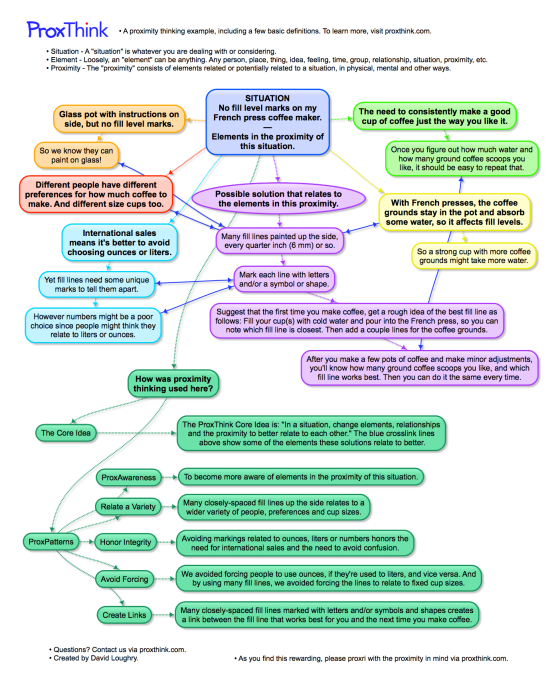
The mind map below should be pretty self-explanatory. Click the image below to open it full-size. Once open, you can zoom it even larger.
NOTE — THE REST OF THIS PAGE IS BASICALLY JUST FOR SEARCH ENGINES.
Since search engines can’t index the text in an image, I’m including the text from the graphic below. However, I’d recommend only looking at the graphic, as it will make a lot more sense. Also, WordPress is adding some blank lines in the outline below, and I can’t fix it. So please imagine there are no blank lines!
• A proximity thinking example, including a few basic definitions. To learn more, visit proxthink.com.
• Situation – A “situation” is whatever you are dealing with or considering.
• Element – Loosely, an “element” can be anything. Any person, place, thing, idea, feeling, time, group, relationship, situation, proximity, etc.
• Proximity – The “proximity” consists of elements related or potentially related to a situation, in physical, mental and other ways.
- SITUATION
No fill level marks on my
French press coffee maker.
—
Elements in the proximity of
this situation.- Different people have different
preferences for how much coffee to
make. And different size cups too. - Glass pot with instructions on
side, but no fill level marks.- So we know they can
paint on glass!
- So we know they can
- The need to consistently make a good
cup of coffee just the way you like it.- Once you figure out how much water and
how many ground coffee scoops you
like, it should be easy to repeat that.
- Once you figure out how much water and
- With French presses, the coffee
grounds stay in the pot and absorb
some water, so it affects fill levels.- So a strong cup with more coffee
grounds might take more water.
- So a strong cup with more coffee
- International sales
means it’s better to avoid
choosing ounces or liters.- Yet fill lines need some unique
marks to tell them apart.- However numbers might be a poor
choice since people might think they
relate to liters or ounces.
- However numbers might be a poor
- Yet fill lines need some unique
- Possible solution that relates to
the elements in this proximity.- Many fill lines painted up the side,
every quarter inch (6 mm) or so.- Mark each line with letters
and/or a symbol or shape.- Suggest that the first time you make coffee, get a rough idea of the best fill line as
follows: Fill your cup(s) with cold water and pour into the French press, so you can
note which fill line is closest. Then add a couple lines for the coffee grounds.- After you make a few pots of coffee and make minor adjustments,
you’ll know how many ground coffee scoops you like, and which
fill line works best. Then you can do it the same every time.
- After you make a few pots of coffee and make minor adjustments,
- Suggest that the first time you make coffee, get a rough idea of the best fill line as
- Mark each line with letters
- Many fill lines painted up the side,
- How was proximity
thinking used here?- The Core Idea
- The ProxThink Core Idea is: “In a situation, change elements, relationships
and the proximity to better relate to each other.” The blue crosslink lines
above show some of the elements these solutions relate to better.
- The ProxThink Core Idea is: “In a situation, change elements, relationships
- ProxPatterns
- Relate a Variety
- Many closely-spaced fill lines up the side relates to a
wider variety of people, preferences and cup sizes.
- Many closely-spaced fill lines up the side relates to a
- Honor Integrity
- Avoiding markings related to ounces, liters or numbers honors the
need for international sales and the need to avoid confusion.
- Avoiding markings related to ounces, liters or numbers honors the
- Create Links
- Many closely-spaced fill lines marked with letters and/or symbols and shapes creates
a link between the fill line that works best for you and the next time you make coffee.
- Many closely-spaced fill lines marked with letters and/or symbols and shapes creates
- Avoid Forcing
- We avoided forcing people to use ounces, if they’re used to liters, and vice versa. And
by using many fill lines, we avoided forcing the lines to relate to fixed cup sizes.
- We avoided forcing people to use ounces, if they’re used to liters, and vice versa. And
- ProxAwareness
- To become more aware of elements in the proximity of this situation.
- Relate a Variety
- The Core Idea
- Different people have different
• Questions? Contact us via proxthink.com.
• Created by David Loughry.
• As you find this rewarding, please proxri with the proximity in mind via proxthink.com.
Suggestions for iPhone folder icons
About the user interface for iPhone folder icons …
With app icons on the iPhone, we have nice big visual cues. With folder icons, they all look the same, and they have one line of very small text at the bottom as the main thing that differentiates them.
Suggestions: It would be great if the text you chose for the folder filled the icon itself. Maybe we could even scale and crop the text, like we scale and crop a wallpaper image, so that just the letters we want fill the icon. And what if we could also choose a color for the icon, or even choose a photo or some clip art for the icon? The iPhone suggests categories when you make a folder, so maybe it could also suggest an image for the icon. Maybe the icon also gets bigger, so a folder icon takes the space of two or four app icons.
How would I describe these suggestions in some proximity thinking terms?
- These changes would honor the integrity of how our eyes work. That’s the whole point of icons in the first place. You can distinguish something at a glance when it’s a good icon.
- These suggested changes are an example of the ProxThink Core Idea, which is: In a situation, change elements, relationships and the proximity to better relate to each other. The situation is the challenge of telling the folder icons apart. Our eyes, our vision, the iPhone screen, technology and readability-at-a-glance are elements and relationships, among others of course, in the proximity of this situation. The suggestions above change elements and relationships (text in icon, scaling, cropping, color, photos, clip art, icon size) for the icons. These change our user relationships to the icons, and in the process also change the proximity of this situation to the extent that perhaps it’s no longer a situation!
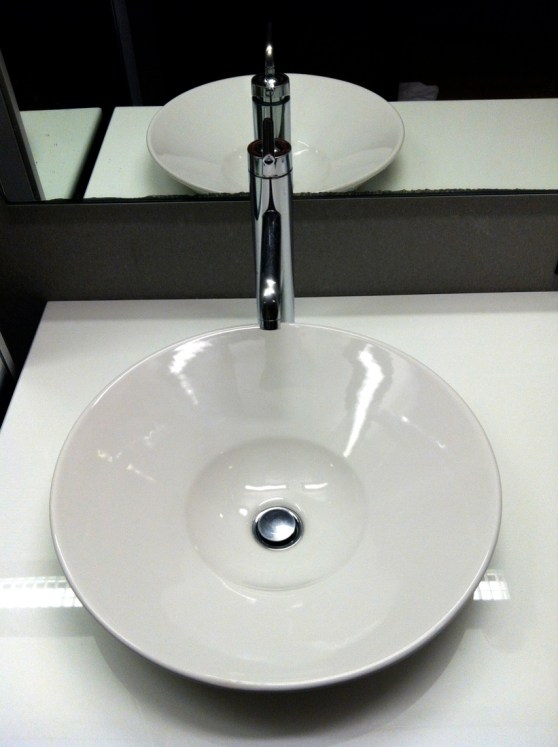
Cool but lame sink?


This hip sink is sort of like fashionable shoes that hurt.
I like being hip and cool as much as the next guy, but not so much in the bathroom.
I stayed at an Aloft Hotel in Dallas recently, and there it was, an uber-cool sink.
Cool, that is, until you try leaning on it when you’re shaving or brushing your teeth or rinsing your mouth.
That’s when the sink cuts into your hand or your arm.
That’s when you know the price of being cool.
I’d like designers to relate to a wider variety of constraints. Why can’t a sink have a cool shape AND be ergonomic? This sink is like a monoculture, being mainly a geometric design, but monocultures are not very sustainable.
Where’s the ProxAwareness? Did they test this on androids or people? Did they try it themselves? They needed to honor the integrity of the hands and arms that will interface with this sink.
They needed to use the Core Idea of proximity thinking: In a situation, change elements, relationships and the proximity to better relate to each other.
Next time, they might want to ProxThink that.
People need ProxSets to function and make sense of their worlds
People need ProxSets to function and make sense of their worlds. That doesn’t mean their ProxSets can’t change. By the way, with proximity thinking, “their worlds” in the first sentence could have also been stated “their proximities.”
Being in a state of some difference and tension with people
It’s both kind of an odd lesson, and obvious from the basics of ProxThink, but you probably need to be in a state of some difference and tension with pretty much everyone you meet. The word some here is important.
For more about differences in relationships, read the paragraph titled “Differences” on this advanced page about relationships.
For more about the importance of some, in contrast to none or all, see the Value of Some.