Some belts always fit just right. Let’s ProxThink about that.

Some belts, like the web belt below which allows the buckle to push through anywhere, always fit just right. Let’s use proximity thinking to consider this situation.

Continuously Adjustable Belt for Proximity Thinking Example

The mind map below explores this situation. Click the image below to open it full-size. Once open, you can zoom it even larger.

Belts that Fit Just RightNOTE — THE REST OF THIS PAGE IS BASICALLY JUST FOR SEARCH ENGINES.
Since search engines can’t index the text in an image, I’m including the text from the graphic below. However, I’d recommend only looking at the graphic, as it will make a lot more sense. Also, WordPress is adding some blank lines in the outline below, and I can’t fix it. So please imagine there are no blank lines!

• A proximity thinking example, including a few basic definitions. To learn more, visit proxthink.com.
• Situation – A “situation” is whatever you are dealing with or considering.
• Element – Loosely, an “element” can be anything. Any person, place, thing, idea, feeling, time, group, relationship, situation, proximity, etc.
• Proximity – The “proximity” consists of elements related or potentially related to a situation, in physical, mental and other ways.

  • SITUATION
    Belts that fit just right.

    Elements in the proximity of
    this situation.

    • Everyone has a
      different size waist.
    • Most belts have a few
      holes rather than being
      continuously adjustable.

      • So belts only fit well if your waist
        matches one of the holes on the belt.
    • Fashion and trends
      considerations.
    • Design and manufacturing
      considerations.
    • Belt materials and
      technology.
    • Poor-fitting belts may have
      physical and psychological
      effects on the wearers.
    • Continuously adjustable
      belts fit the best.

      • Such as web belts that allow the buckle to
        push through anywhere. Or, belts with buckles
        that can grasp the belt at any point.
      • Let’s think about this from a
        proximity thinking point of view.

        • ProxPatterns
          • Transition Smoothly
            • Continuously adjustable belts transition smoothly between any size waist. They
              adjust if you want them a bit looser after a meal, or a bit tighter if you’re slimmer.
          • Honor Integrity
            • Continuously adjustable belts honor the characteristics of your exact waist size.
          • Avoid Forcing
            • Continuously adjustable belts avoid forcing you to live
              with a belt that is a little too snug or a little too loose.
    • Some people may be willing to
      put up with a less-than-perfect fit
      to get other benefits.

      • Let’s think about this from a
        proximity thinking point of view.

        • ProxPatterns
          • Honor Integrity
            • For some people, fashion may outweigh comfort considerations.
              They have a higher regard for fashion than for comfort, and in
              doing so they honor the integrity of fashion in their life.
          • ProxAwareness
            • Belts with holes are more widely sold than continuously adjustable
              belts. So consumers, retailers, designers and manufacturers may
              be less aware of the benefits of a belt with perfect fit.
          • Limits of One
            • There are limits of any one technology or style to be accepted
              or used. So there may be limits to the widespread adoption of
              continuously adjustable belts.

• Questions? Contact us via proxthink.com.
• Created by David Loughry.
• As you find this rewarding, please proxri with the proximity in mind via proxthink.com.

My Bodum French Press Could Use Some Proximity Thinking

My French press coffee maker, by Bodum, could use some proximity thinking. More specifically, it has no fill level marks to help me add water to the same place every time, as you can see from the picture.

UPDATE: I made a short video intro to this post! You can watch it here.

Bodum French Press for Proximity Thinking Example

The mind map below should be pretty self-explanatory. Click the image below to open it full-size. Once open, you can zoom it even larger.

NOTE — THE REST OF THIS PAGE IS BASICALLY JUST FOR SEARCH ENGINES.
Since search engines can’t index the text in an image, I’m including the text from the graphic below. However, I’d recommend only looking at the graphic, as it will make a lot more sense. Also, WordPress is adding some blank lines in the outline below, and I can’t fix it. So please imagine there are no blank lines!

• A proximity thinking example, including a few basic definitions. To learn more, visit proxthink.com.
• Situation – A “situation” is whatever you are dealing with or considering.
• Element – Loosely, an “element” can be anything. Any person, place, thing, idea, feeling, time, group, relationship, situation, proximity, etc.
• Proximity – The “proximity” consists of elements related or potentially related to a situation, in physical, mental and other ways.

  • SITUATION
    No fill level marks on my
    French press coffee maker.

    Elements in the proximity of
    this situation.

    • Different people have different
      preferences for how much coffee to
      make. And different size cups too.
    • Glass pot with instructions on
      side, but no fill level marks.

      • So we know they can
        paint on glass!
    • The need to consistently make a good
      cup of coffee just the way you like it.

      • Once you figure out how much water and
        how many ground coffee scoops you
        like, it should be easy to repeat that.
    • With French presses, the coffee
      grounds stay in the pot and absorb
      some water, so it affects fill levels.

      • So a strong cup with more coffee
        grounds might take more water.
    • International sales
      means it’s better to avoid
      choosing ounces or liters.

      • Yet fill lines need some unique
        marks to tell them apart.

        • However numbers might be a poor
          choice since people might think they
          relate to liters or ounces.
    • Possible solution that relates to
      the elements in this proximity.

      • Many fill lines painted up the side,
        every quarter inch (6 mm) or so.

        • Mark each line with letters
          and/or a symbol or shape.

          • Suggest that the first time you make coffee, get a rough idea of the best fill line as
            follows: Fill your cup(s) with cold water and pour into the French press, so you can
            note which fill line is closest. Then add a couple lines for the coffee grounds.

            • After you make a few pots of coffee and make minor adjustments,
              you’ll know how many ground coffee scoops you like, and which
              fill line works best. Then you can do it the same every time.
    • How was proximity
      thinking used here?

      • The Core Idea
        • The ProxThink Core Idea is: “In a situation, change elements, relationships
          and the proximity to better relate to each other.” The blue crosslink lines
          above show some of the elements these solutions relate to better.
      • ProxPatterns
        • Relate a Variety
          • Many closely-spaced fill lines up the side relates to a
            wider variety of people, preferences and cup sizes.
        • Honor Integrity
          • Avoiding markings related to ounces, liters or numbers honors the
            need for international sales and the need to avoid confusion.
        • Create Links
          • Many closely-spaced fill lines marked with letters and/or symbols and shapes creates
            a link between the fill line that works best for you and the next time you make coffee.
        • Avoid Forcing
          • We avoided forcing people to use ounces, if they’re used to liters, and vice versa. And
            by using many fill lines, we avoided forcing the lines to relate to fixed cup sizes.
        • ProxAwareness
          • To become more aware of elements in the proximity of this situation.

• Questions? Contact us via proxthink.com.
• Created by David Loughry.
• As you find this rewarding, please proxri with the proximity in mind via proxthink.com.

Proximity Thinking about the California Drought

How can proximity thinking be used to think about, and relate to, the current California drought?

The mind map below should be pretty self-explanatory. Click the image to open it full-size. Once open, you can zoom it even larger.

NOTE — THE REST OF THIS PAGE IS BASICALLY JUST FOR SEARCH ENGINES.
Since search engines can’t index the text in an image, I’m including the text from the graphic below. However, I’d recommend only looking at the graphic, as it will make a lot more sense. Also, WordPress is adding some blank lines in the outline below, and I can’t fix it. So please imagine there are no blank lines!

• A proximity thinking example, including a few basic definitions. To learn more, visit proxthink.com.
• Situation – A “situation” is whatever you are dealing with or considering.
• Element – Loosely, an “element” can be anything. Any person, place, thing, idea, feeling, time, group, relationship, situation, proximity, etc.
• Proximity – The “proximity” consists of elements related or potentially related to a situation, in physical, mental and other ways.

  • SITUATION
    California Drought

    Elements in
    the proximity of this
    situation.

    • Need for water
      savings.
    • A challenge shared by
      everyone in the region.

      • Consequences of failing to
        reduce water use.
    • How much water are
      we saving?
    • Incentives to save water.
      • Save money.
      • Avoid penalties.
      • To help yourself as
        well as others.
      • What other kinds of
        rewards might there be?
    • What are ideas for saving water,
      and how do we share them?
    • Lack of enough rain
      for many years.
    • Water sources and
      related resources.
    • People, organizations, equipment
      and infrastructure in the region.
    • To what extent are our
      efforts coordinated?

      • How could this be improved?
    • Weather and forecasts.
    • Related technology,
      tools and processes.
    • How can proximity thinking be used for this situation?
      • The ProxThink Growth Model, for people who share a proximity, has four main parts:
        • Vadi Agreements
          • Vadi Agreements
            acknowledge valuable
            differences and provide
            ways to sustain them.
          • Enough water to meet
            or exceed needs is a
            valuable difference.
          • This water vadi helps
            support many things, like
            survival, sustainability,
            stability, health, happiness
            and vibrant communities.
          • Vadi Agreements can be
            explicit (legal, contractual),
            or informal, as well as the
            general agreement that
            we’re in this together.
          • Agreements can also include
            goals for water savings, which
            ProxMonitors can help track.
        • ProxMonitors
          • A way to monitor and track
            water savings and other
            related information at different
            levels (personal,
            organizational, local, regional).
          • Proximity monitors increase
            proximity awareness, which can
            help many kinds of relationships.
          • Can be both technological
            monitors and people
            reporting current conditions.
        • Proxri
          • Sharing an idea for saving
            water is also a proxri.
          • Proxri are rewards which relate elements
            in the proximity. So such rewards are
            often made with the proximity in mind.

            • Water you save is a proxri
              to yourself and others in
              the proximity.
          • Proxri can be money, or result in
            money, but the idea is much broader
            than money, and acknowledges the
            need for a wide variety of rewards.
          • Water savings may or may not
            result in money but these proxri can
            benefit multiple levels (personal,
            organizational, local, regional).
          • People may see proxri
            made by others, or needed
            proxri, at RelatePoints.
        • RelatePoints
          • Ideas for saving water can be
            shared via RelatePoints.
          • A primary place for coordinating
            relationships in this proximity.
          • A place to connect and access
            ProxMonitors, Vadi
            Agreements, Proxri (made and
            needed), and other related info.
          • Could be a website
            and/or a mobile app.
        • Are there other benefits to the ProxThink Growth Model approach?
          • We may develop new ways of
            managing shared challenges.
          • Since it enables people to see and relate to proximities in a wider
            variety of ways, it can lead to more variety in our lives, one of the
            keys to health, happiness, sustainability and vibrant communities.
          • It may help us realize how
            many proximties we share.

• Questions? Contact us via proxthink.com.
• Created by David Loughry.
• As you find this rewarding, please proxri with the proximity in mind via proxthink.com.
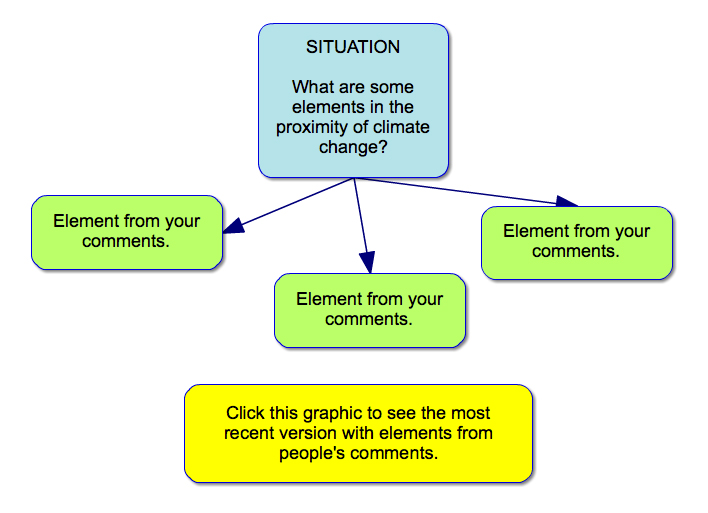
Public Collaboration: What are some elements in the proximity of climate change?

Climate Change Collaboration

As part of our Let’s ProxThink Hangouts On Air, let’s think about climate change. You can comment here with elements you think are in the proximity of climate change. I’ll define proximity and two other terms below. I’ll add some of your elements to the mind map above. You can click on it to see a larger version. Then we can discuss it in future Hangouts On Air. Remember, by participating, you might get proxri as part of our collaboration deal.

A situation is whatever you are dealing with or considering. In this case, our situation is climate change.

Loosely, an element can be anything. Any person, place, thing, idea, feeling, time, group, relationship, situation, proximity, etc.

The proximity consists of elements related or potentially related to a situation, in physical, mental and other ways.

Putting the terms together with our situation, elements in this proximity could be people, places, things, ideas, feelings, times, groups, relationships, situations, and proximities that are related or potentially related to climate change.

So, what are some elements in the proximity of climate change? Please add your comments below.

Thanks and check our upcoming events page and/or follow ProxThink for announcements about upcoming Hangouts On Air, when we may work on this climate change collaboration!

And remember, by participating, you might get proxri as part of our collaboration deal.

Variety is my carrot. Climate change is my stick.

Variety is my carrot, since most people like variety and often want a bit more of it. Climate change is my stick, since we’re pretty much going to have to do more about climate change. But whether you’re motivated by variety, climate change, or both, learning and using the proximity thinking framework can make a difference.

Let’s start with the stick. If you believe in climate change, why wouldn’t you explore a new framework for thinking about it and dealing with it? The framework I’m talking about is proximity thinking, and especially one part of it called the sustainable proximities approach. However, if you do not believe in climate change, then you should also not believe in insurance. Because doing something to lessen the impact and threat of climate change is essentially getting some insurance. And, if you do not believe in insurance, then good luck to you, my friend, because there will likely come a day when you need some luck.

On the carrot side, if you do not believe in climate change, then perhaps you do believe in a life with some variety. Or if it hasn’t really become a belief, I’ll bet you at least want some variety in your life. And if you think about variety for a while, you’ll realize that what you probably want is sustainable variety. But then we are back to this new framework for thinking called proximity thinking. Part of the framework is the idea of sustainable proximities. How does that relate to variety? Here’s the thing: I think sustainable proximities and sustainable variety go together. I think they help create each other and enhance each other. Of course, it’s possible you don’t believe in, or want, some variety in your life. Again, I wish you the best of luck, because probably, no matter how great your life is, there will come a day when you get tired of it, and want some variety. If you, and we, don’t have ways of getting sustainable variety, we’re going to be depending on luck for the needed variety, and some of that variety may not be as pleasant as we like. If your life is working for you just fine as is, it’s probably partly because you’re getting enough variety. But getting enough variety is partly about keeping your eyes open for new kinds of variety, so sustainable proximities should interest you as well, in your quest for ongoing, sustainable variety.

So now you have both a carrot and a stick to help get you to explore proximity thinking!