Two ProxThink That webinars have been added for September 15 and 16! Learn more and register here: proxthink.eventbrite.com.
Author Archives: David Loughry
“How to ProxThink That” Webinar Series Launched
We’ve launched a new webinar series, our first! Combining a conference call and online work, this interactive intro webinar will help you learn How to ProxThink That. Limited to 24 people, this interactive session may fill up quickly. It will be hosted by David Loughry, creator of proximity thinking. The first sessions will be August 25th and 26th.
You can find links to current webinars via our Eventbrite page at:
http://proxthink.eventbrite.com
As of today, here are the key event details.
What we’ll do:
1. Introduce you to the ProxThink framework and tour the site.
2. Practice generating ideas using ProxPatterns and the Growth Model. To relate to your life, we’ll practice generating ideas for social, business and community situations.
3. Q&A (Questions and Answers)
What’s included (after the session):
1. You’ll have a post-session call with David, any time within a year, for further questions or discussion (up to 15 minutes).
2. You’ll get a ProxThink website membership, which includes the power to turn off ads, space for saving ideas, and a way to track your learning.
3. You’ll be sent a printable PDF of the ProxPatterns formatted to cut out for your wallet or purse. Feel free to share this with others.
What you’ll get:
1. New perspective, new framework, mental stimulation and a quicker onramp: You’ll gain a new way of looking at the world and a new framework that gives you more options for thinking, creating, innovating, solving problems, boosting sustainability, and living. Plus there’s the mental stimulation, and a quicker onramp to learning about proximity thinking than learning it on your own.
2. New ideas and the satisfaction of helping others: We’ll develop ideas during the session for some situations you and others may face. You may benefit and possibly help others too.
3. Possibility of proxri for you: We may make public some ideas we develop, via the ProxThink River blog. For both the public ideas, and ideas only the session participants can access, you’ll have the possibility of getting proxri for them from a session participant or someone out there in the wide world.
What you’ll need:
1. A phone or a way to make voice calls via Skype. Either will do.
2. A computer. You will want at least two browser windows open at once, so the bigger the screen the better.
3. A Google account, so you can access the shared Google Doc we’ll be working on. Please know the email associated with your Google account BEFORE registering. (You can get a Google account without getting Gmail, if you want, using your existing email account.)
For current suggested pricing, and to find a date that works for you and to register, please visit:
http://proxthink.eventbrite.com
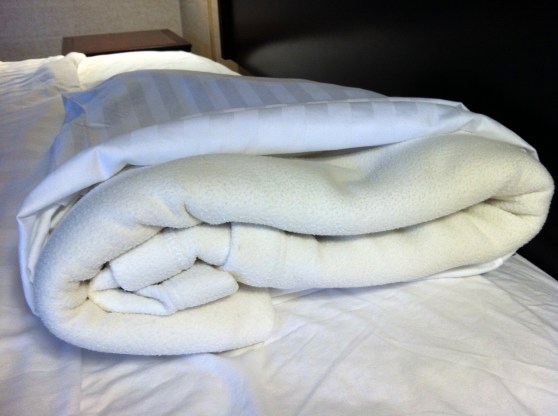
How to make an ergonomic pillow from a blanket when you are traveling.

Enjoying this post, or using it? Consider a proxri. Thank you!
•••
I didn’t create this innovation, but I helped trigger it through the use of two ProxPatterns. It also illustrates how it can take multiple people to innovate. I’ll tell you the story first, and then mention the proximity thinking involved.
I use an ergonomic pillow at home, but don’t travel with it. I’ve never found a hotel that offers them. I was in Denver at a hotel, needed an extra blanket, and went to the front desk. After I got the blanket, I thought, hey, it never hurts to ask, so I said, “This is going to be a crazy question, but by any chance do you have an ergonomic pillow?”
The front desk clerk said, “What’s an ergonomic pillow?” I explained it to him, and drew a shape in the air that shows the side of an ergonomic pillow. And he said, “Oh, I know what those are. Those are cool.” Then he went back into the supply room.
When he came back, he had one of those foamy blankets folded inside a pillowcase. He said “Would this help?” I said, “Yeah, maybe, thanks so much! That’s a great idea!” It wasn’t exactly the right shape, but the basic idea was born.
In the hotel room, I experimented and tweaked it. I found that with a different blanket, and a different way of folding it, I could mimic the shape and firmness of my ergonomic pillow at home.
The photo you see is after four nights of sleeping on the pillow. It was the best four nights of sleep I think I’ve had in a hotel. I thank that hotel clerk and the Drury Inn. I wonder if they encourage this kind of customer service from their staff?
Obviously, my tweaking of the clerk’s idea didn’t take any great talent. But asking him the question about whether they had ergonomic pillows was the result of two ProxPatterns I often use. One is seeking greater ProxAwareness. The other is allowing some uncertainty in asking a dumb question.
This led in turn to examples of two other ProxPatterns. The front desk clerk was seeking to honor the integrity of my request. He did this partly by ProxAwareness of the available resources. And partly by relating a wider variety of elements than normal, those elements being pillowcases and blankets. Normally, blankets don’t go inside pillowcases, but the clerk was able not only to consider it, but try it too, which is a great example of relating a variety.
Of course he didn’t consciously use those ProxPatterns. But I have found that useful and/or interesting ideas and processes often exhibit ProxPatterns.
Enjoying this post, or using it? Consider a proxri. Thank you!
People need ProxSets to function and make sense of their worlds
People need ProxSets to function and make sense of their worlds. That doesn’t mean their ProxSets can’t change. By the way, with proximity thinking, “their worlds” in the first sentence could have also been stated “their proximities.”
McDonald’s has the Worst In-Store Menus

The font size on the menus in McDonald’s restaurants is way too small. The font size does not honor the integrity of the visual abilities of most people. It’s really quite bizarre. They are the worst in-store menus I’ve ever seen. I wonder if the graphic designers ever stood and looked at the menus after they were manufactured. Maybe an executive or manager made them design them this way against their will!
But I suppose, what can we expect from the corporation that is costing the global population billions of dollars in healthcare expenses due to the unhealthiness of the food they serve? On the other hand, it’s not really all their fault. McDonald’s operates within systems, those being markets and governments and even culture, which tend to emphasize elements first, relationships second, and proximities last. So, for example, elements like money and individuals (people’s own momentary desires and point of view) tend to get the most attention and effort. Relationships often come second, such as relationships with friends, other customers and employees, as well as relationships between food and health, vitality and energy. Last comes awareness and efforts regarding the general health and well-being of the population, the environment, healthcare expenses, and sustainability, all of which are aspects of proximities related to situations involving food and eating. Of course, most of us operate within such dysfunctional systems. So you can’t have really high expectations for most anyone or anything.
What is needed are models which allow for and integrate elements, relationships, and proximities, letting us think about and relate to each as appropriate. The ProxThink growth model is an attempt at a such a model. And it is more than just a set of ideas. The growth model can be implemented in what is called the sustainable proximities approach, which can complement or augment existing systems if needed, as well as be deployed on its own.
‘Broken Windows’ Policing Strategy and Proximities
Communities and neighborhoods are proximities, and proximities matter. In a telling comment, former police chief Bratton had this brief summary of what Wilson and Kelling were saying with their so-called “broken windows” policing strategy:
“The importance of what Wilson and Kelling wrote was the emphasis not only on crime committed against people but the emphasis on crimes committed against the community, neighborhoods,” Mr. Bratton said.
The above quote is from the New York Times story about James Q. Wilson at the time of his death. They say “his ‘broken windows’ theory of law enforcement laid the groundwork for crime reduction programs in New York, Los Angeles and other cities.” The full story is here.
