Explain that to me

I think I’ll start a new series called “Explain that to me.”

On most blocks, and in most neighborhoods, and in most cities, there are no public places to sit outside and have community. Places that are either not privately owned, or not serving some other purpose like a street or sidewalk. Explain that to me. How does that honor the integrity of what humans need?

I wrote this sitting on the ground, on a concrete sidewalk.

Kudos to Starbucks

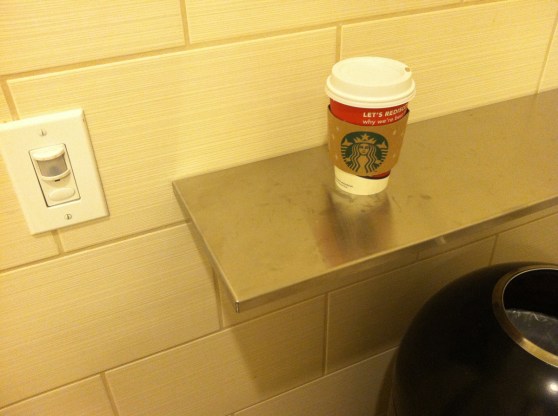
This shelf to hold your drink is in the restroom of a newly remodeled Starbucks in California I went to recently. It recognizes that you are likely to have a drink in your hand when you enter the restroom. It helps you out and makes Starbucks look smart.

This is a nice example of the Core Idea of proximity thinking, as well as a few ProxPatterns.

The Core Idea states that: In a situation, change elements, relationships and the proximity to better relate to each other. Starbucks added the element of the shelf to the proximity of the restroom. This helps other elements in the proximity, such as people and coffee cups, better relate to the restroom. It helps people better relate to elements like the toilet, sink and hand dryer. It keeps the coffee cup safer, cleaner, and easily reachable. Coat hooks perform a similar improvement for restrooms. Both get unneeded things out of the way temporarily.

You also might come to an idea like the restroom coffee shelf via ProxPatterns. You might, with ProxAwareness, notice there is no good place to put your coffee when you enter the restroom after you yourself get a cup. You might think, I wonder if something could be done about this (Value of Some). There might be other things people want to put down temporarily (Relate a Variety), so the shelf should be wider than just a cup. You might also use the transition smoothly ProxPattern, by placing the shelf next to the side of the door which opens, so people will see it right away.

Being in a state of some difference and tension with people

It’s both kind of an odd lesson, and obvious from the basics of ProxThink, but you probably need to be in a state of some difference and tension with pretty much everyone you meet. The word some here is important.

For more about differences in relationships, read the paragraph titled “Differences” on this advanced page about relationships.

For more about the importance of some, in contrast to none or all, see the Value of Some.

A possible criticism and an answer

A possible criticism of the Underlying Concept (being is about relating) of proximity thinking might be this: “Sure, life is about relationships. But not just any old relationships!”

My answer is I agree, and the ProxPatterns help suggest relationships more likely to work and enhance life. That doesn’t mean the ProxPatterns are free of contradictions. In fact, they allow and work with contradictions.

Horrible Movie Seats

I had the most horrible experience at the movies last night. We saw this new film called “A Dangerous Method.” We sat in the second row, far off to the right side. I spent the whole time looking far up and to the left, at gigantic distorted faces (due to the severe angle from my seat). The movie was sold out so we couldn’t move to better seats.

NO ONE should EVER be seated that close to the screen. Well, and have to pay for it. Maybe if they paid me to sit there, that would’ve been different. It was such a strange, uncomfortable experience that it was hard to pay attention to the film. They should not even have seats installed that close to the screen!

I’m not sure if it was the movie theater designers, or the business owners, but people were not thinking when they designed that theater. We were at the Landmark Theatre at 10850 W Pico Blvd, Los Angeles, CA 90064.

The theater owners and designers both had poor ProxAwareness, as far as being aware of what sitting there is actually like.

Their ProxSet for this situation included the elements of money, and the customer’s experience, and of course other elements. It seems they honored the integrity of the element of money more than the element of the customer’s experience! This strategy can often work in the short term, and often not work in the long term.

Of course it didn’t help that “A Dangerous Method” is so far out of the ordinary experience of most people, that it might as well be a science fiction film. It didn’t honor the integrity of what being a human being is like, to any great degree.

So many films these days depend on some gimmick or contrived situation. I had hoped that “A Dangerous Method” would be different, but somehow it really wasn’t.

I suggest that David Cronenberg take some time off from moviemaking, and spend more time with regular people. Ordinary life is far more interesting and full of possibilities.

Of course I’m not saying there isn’t a market for David Cronenberg’s films. And of course I might have liked the film more, and been less cranky, if I hadn’t had such horrible movie seats!

Landmark Theatres may have other blind spots. I’d be glad to help them do some proximity thinking via seminars, collaboration or idea sessions.
Is this restroom occupied or vacant?

This is a door on the brand new public restrooms at a Santa Monica, California beach near Montana avenue.

These are individual stalls. One per person, each with its own door. Does anything seem missing?

How about one of those signs that show whether the stall is occupied or vacant? The temporary portable restrooms that were there during construction of this building had occupied/vacant signs. Isn’t it bizarre that the new building lacks them? Hundreds of people a day use these restrooms.

I know they make occupied/vacant signs for this type of door. I’ve seen them.

In ProxThink terms, an occupied/vacant sign uses Connected Independence to increase ProxAwareness. You know whether someone is in there independent of having to knock or try the handle.

For more, see Connected Independence and ProxAwareness.